

- By Javier Martínez
- ·
- Posted 10 Aug 2021
Functional patterns
Welcome pythonistas! In our last video session on design patterns we focused exclusively on patterns for the object oriented paradigm (OOP). To some..


Last post we looked at printing whilst holding state. Here's the code we ended up with:
-- our Transaction type
data Transaction = Deposit Int | Withdrawal Int

-- our bank functions
deposit :: Monad m => Int -> StateT [Transaction] m ()
deposit amount = modify $ \transactions -> transactions ++ [Deposit amount]

withdraw :: Monad m => Int -> StateT [Transaction] m ()
withdraw amount = modify $ \transactions -> transactions ++ [Withdrawal amount]

printStatement :: (Monad m, MonadStatementPrinter m) => StateT [Transaction] m ()
printStatement = do
  transactions <- get
  let statement = toStatement transactions
  lift $ printSt statement

-- in our test file
it "deposits money" $ do
  runIdentity (execStateT (deposit 100) newBank) `shouldBe` [Deposit 100]

it "withdraws money" $ do
  runIdentity (execStateT (withdraw 100) newBank) `shouldBe` [Withdrawal 100]

it "prints a statement" $ do
  execWriter (evalStateT printStatement [Deposit 100]) `shouldBe` "Desposited 100 | Balance 100\n"
Our final task to complete the kata is to add a date to the transactions. We will implement this in small logical steps, using the compiler and the tests to drive our design. Let's begin!
Transaction to contain a dateimport Data.Time
data Transaction = Deposit Int UTCTime | Withdrawal Int UTCTime
This will cause a compile time error - deposit and withdraw are not creating a valid Transaction type anymore, as well as our test functions. We will add a fixed date to these so we can compile.
firstOfJan2019 = UTCTime (fromGregorian 2019 01 01) (secondsToDiffTime 0)

-- ...
deposit amount = modify $ \transactions -> transactions ++ [Deposit amount firstOfJan2019]

-- same for `withdraw`, and in test functions
Now we have modified our type to be the shape we want, we can think about how to get the current date into the transaction, again without sacrificing testability. We will continue to follow the monad transformers style by adding a type constraint to our m.
MonadCurrentDateTime type constraintclass MonadCurrentDateTime m where
currentDateTime :: m UTCTime
Now we want to use this type as a constraint in our deposit and withdraw methods to ensure we can use it.
deposit :: (Monad m, MonadCurrentDateTime m) => Int -> StateT [Transaction] m ()

withdraw :: (Monad m, MonadCurrentDateTime m) => Int -> StateT [Transaction] m ()
The compiler tells us what to do next.
Main.hs:15:3: error:
  • No instance for (MonadCurrentDateTime IO)
      arising from a use of ‘deposit’

...

BankSpec.hs:31:32: error:
  • No instance for (MonadCurrentDateTime Identity)
      arising from a use of ‘deposit’
As the compiler says, our usage of deposit is invalid because IO is not an instance of MonadCurrentDateTime, and so can't give us a currentDateTime function to use. A similar scenario is happening in our test file. Let's fix both.
instance MonadCurrentDateTime IO where
  currentDateTime = getCurrentTime -- this comes from Data.Time

-- in our test file
instance MonadCurrentDateTime Identity where
  currentDateTime = pure firstOfJan2019
Now we're compiling, and our tests our passing because we hardcoded the date in our Bank code. Now let's use the 'real' date (as far as our functions are concerned).
MonadCurrentDateTime typeclassdeposit amount = do
now <- lift currentDateTime
modify $ \transactions -> transactions ++ [Deposit amount now]
It's as simple as that :). We are now using the date returned in our Identity instance of MonadCurrentDateTime. You can now do the work to add the date into the statement output, which I'll leave out of the scope of this post.
Let's write one last test as an acceptance test that proves everything is working together.
-- we'll need an instance of `Writer String` for `MonadCurrentDateTime` for our test
instance MonadCurrentDateTime (Writer String) where
  currentDateTime = pure firstOfJan2019

testMyBank :: StateT [Transaction] (Writer String) ()
testMyBank = do
  deposit 200
  withdraw 100
  deposit 3000
  printStatement

-- output changed to match what the statement should look like
it "can deposit, withdraw and print a statement" $ do
  execWriter (evalStateT testMyBank []) `shouldBe` "\ \date || credit || debit || balance\n\ \01/01/2019 || 200.00 || || 200.00\n\ \01/01/2019 || || 100.00 || 100.00\n\ \01/01/2019 || 3000.00 || || 3100.00\n"
And we are done!
Notice how we didn't need to change the usage of our functions in Main.hs, the API stayed the same, we merely added some more functionality.
Welcome pythonistas! In our last video session on design patterns we focused exclusively on patterns for the object oriented paradigm (OOP). To some..

Solving a simple problem in Elixir In this article, I am going to solve the Word Count problem from Exercism in Elixir. I'll start with a form that..
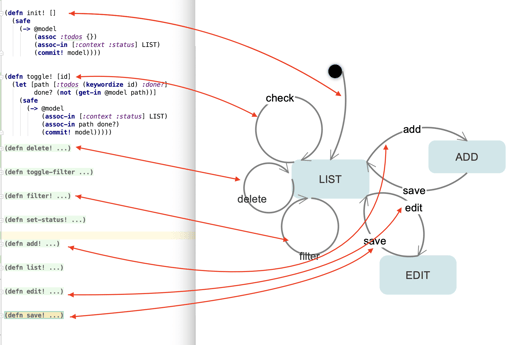
Crafting web apps using finite state machines - Part 1 Code on Gitlab
Join our newsletter for expert tips and inspirational case studies
Join our newsletter for expert tips and inspirational case studies